

Shakespeare's lovers, in song.
Frozen Thoughts is a new song cycle by Ryan Kalin that brings couples from five of Shakespeare's plays onto one stage. Use this guide to meet the characters and get comfortable with the language before you see the show.
Macbeth: A Musical Adaptation by Ryan Kalin · October 2025
- The show
- A new song cycle
- Written & composed by
- Ryan Kalin
- Directed by
- Aidan Colon
- Performances
- February 5–13, 2027
- Where
- Metuchen and Plainfield, NJ
What is Frozen Thoughts?
Frozen Thoughts is a new song cycle by Ryan Kalin, built from scenes in five of Shakespeare's plays: Romeo and Juliet, Troilus and Cressida, Macbeth, Othello and Much Ado About Nothing. Its title comes from a sixth, The Two Gentlemen of Verona.
The show puts lovers, partners, friends and rivals from these plays on the same stage and finds unexpected connections between them: jealousy, devotion and tyranny, all in the name of love. Scenes of Shakespeare's dialogue sit between the songs to carry the stories and link one moment to the next. A Narrator guides the audience through the evening, which opens with a sonnet.
Frozen Thoughts is part of Shakespeare Sounds, our program that brings Shakespeare to new audiences through music, and of RECKONING, our 2026–27 season.
This weak impress of love is as a figure
The Duke · The Two Gentlemen of Verona, Act 3, Scene 2
Trenchèd in ice, which with an hour's heat
Dissolves to water and doth lose his form.
A little time will melt her frozen thoughts,
And worthless Valentine shall be forgot.
The Duke is telling Thurio that Silvia's love for Valentine is like a shape carved in ice. Give it time and it will melt. Impress: an impression, like a stamp in wax. Trenchèd: cut or carved.
From the composer
Ryan Kalin on turning Shakespeare's language into songs.

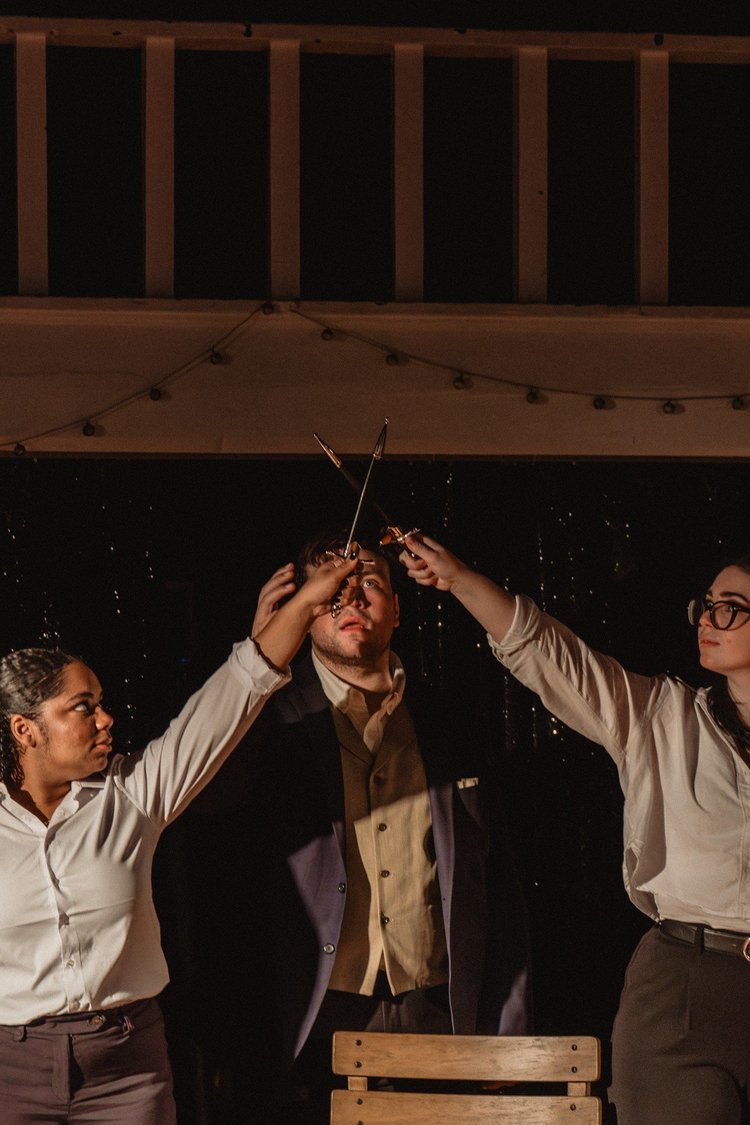
Macbeth: A Musical Adaptation · October 2025
Shakespeare is a brilliant writer thanks to his ability to place language in the seemingly correct place every single time. We easily feel devastated by Juliet's “Wash they his wounds with tears? Mine shall be spent, / When theirs are dry, for Romeo's banishment” and startled when Iago pierces the skin with “I'll pour this pestilence into his ear.” In these moments, there is nothing else we could have asked for.
Adapting Shakespearean text into music is no different. I always think critically about the nature of the passage and its context within the play. Throughout the process, I can't forget about the character who will be singing the song onstage. Suspension of disbelief can only extend so far.
Would this person feel authentically compelled to sing in this manner? What would their vocal register and tone of voice be like? What sort of music is accompanying them, and what instruments should support the action? Each of these things influences the others profoundly, and we theatre composers have a responsibility to support the objective of the text as best we can.
Ryan KalinWriter and composer, Frozen Thoughts
Quoted lines: Romeo and Juliet, Act 3, Scene 2; Othello, Act 2, Scene 3.
The plays
Five plays share the stage, and a sixth gives the show its name. Here's who you'll meet and what each play brings.
The Two Gentlemen of Verona
Gives the show its name
Themes from this play run through Frozen Thoughts, but its main job is to supply the title and the idea behind it: a love that seems frozen in place can melt with time.
Romeo and Juliet
In the show
The tragedy of two young lovers, and the way youth itself works against their romance.
- Romeo
- Young and impulsive, Romeo is taken by Juliet's beauty in a way that both surprises and scares him. Desperate for his love to be returned, he struggles with the limits his own family name puts on him.
- Juliet
- Not quite fourteen, Juliet is caught in a seemingly unstoppable series of events. She is smart, but youth and inexperience keep her from overcoming the family forces that stand between her and her new feelings.
- Friar Laurence & the Nurse
- Romeo's and Juliet's trusted guides. The lovers turn to them whenever they need advice.
Troilus and Cressida
In the show
Scenes that explore the bond between Achilles and Patroclus. Readers of Greek myth have long seen something romantic in it, and the intensity of their friendship challenges the idea that these two warriors are only comrades.
- Achilles
- Supposedly the greatest Greek warrior, Achilles often needs encouragement when his pride is hurt and his spirits are low.
- Patroclus
- Achilles' best friend and biggest supporter.
- Thersites
- The play's fool, never slow with a sharp-tongued remark.
- Ulysses
- A Greek leader known for his intellect.
Macbeth
In the show
An inside look at partners with a powerful influence on each other, and at how a relationship can rise and fall through violence.
- Macbeth
- The king to be, according to the prophecy. Easily manipulated, yet often his own victim.
- Lady Macbeth
- Hungry for more, she believes her husband should chase power with uncontrollable want.
- Attendant
- The trusty right hand.
Othello
In the show
Othello is famous for jealousy and planned deception. In Frozen Thoughts it takes the savagery of Macbeth and turns it into a psychological study.
- Iago
- A classic Shakespearean villain and a master of deception, quick to turn others with cunning language.
- Roderigo
- Iago's easily fooled companion. A listening ear who is used, then dropped when he's no longer needed.
- Othello
- A respected general, increasingly tormented as his marriage is manipulated.
- Desdemona
- Othello's wife, and in the end a victim of his destructive jealousy.
- Cassio
- Othello's newly chosen lieutenant. Being picked over Iago makes him an easy target for Iago's schemes.
- Emilia
- Iago's wife and Desdemona's close companion.
Much Ado About Nothing
In the show
Comic relief that ties up loose ends, centered on one relationship that captures the spirit of every scene before it.
- Beatrice
- Witty, resolute and faithful. She stands up for what she knows is right and treats people the way they treat her.
- Benedick
- Aloof, smart and loving. He adores Beatrice despite failed efforts and plenty of quick-tongued exchanges.
How to read Shakespeare
His language can feel like a barrier, but it's dense and precise, which is exactly what makes it work onstage. Ryan's steps for any line that stops you.
Say it out loud
Language is meant to be spoken. Even out of context, what does it feel like the line is saying?
Consider the context
Who is speaking, and to whom? Is this a tender moment, a threat, a joke?
Find the unfamiliar words
Some words mean something a little different in Shakespeare. Hearing the line aloud often makes the meaning clear.
See what comes next
The reply, or the next line, usually shows how the first one landed.
Watch the play
Things come together when you see Shakespeare in the medium he wrote for. Libraries and the internet are full of films and recorded stage productions.
Prefer to watch? Ryan walks through it in How to Understand Shakespearean Language.
I wonder that you will still be talking, Signior Benedick: nobody marks you.
Beatrice · Much Ado About Nothing, Act 1, Scene 1
- Say it. Out loud, it sounds like a put-down.
- Context. It isn't tender, but it is a little flirty. Is Beatrice writing Benedick off for good, or is this an offhand jab?
- Words. From the sound of the line, “marks” means notices or pays attention to.
- What comes next. Benedick fires back: “What, my dear Lady Disdain! are you yet living?” He clearly knows how to return what she dishes out.
Your turn: a line from Iago
Thus do I ever make my fool my purse;
Iago · Othello, Act 1, Scene 3
For I mine own gained knowledge should profane
If I would time expend with such a snipe
But for my sport and profit.
- Say it. Do you feel villainous? You should.
- Context. What kind of man has Iago shown himself to be so far? Is this outburst in character? (No surprises here.)
- Words. What could it mean to make your fool your purse? Maybe using someone for your own “sport and profit.” A snipe is a fool.
- What comes next. He keeps going: “I hate the Moor, / And it is thought abroad that 'twixt my sheets / He has done my office.” He stays on this track for the rest of the speech.
Listen for these lines
Shakespeare's words turn up inside Ryan's songs. Here they are as Shakespeare wrote them. In the show, some are reshaped to fit the music.

Come, thick night,
Lady Macbeth · Macbeth, Act 1, Scene 5
And pall thee in the dunnest smoke of hell,
That my keen knife see not the wound it makes,
Nor heaven peep through the blanket of the dark…
Pall: wrap, as in a funeral cloth. Dunnest: darkest.
Thou knowest the mask of night is on my face,
Juliet · Romeo and Juliet, Act 2, Scene 2
Else would a maiden blush bepaint my cheek
For that which thou hast heard me speak tonight.
Bepaint: color. Juliet is glad it's dark, so Romeo can't see her blush.
To this effect, Achilles, have I moved you.
Patroclus · Troilus and Cressida, Act 3, Scene 3
Moved: urged. Patroclus has been pushing Achilles to rejoin the fight.
Ryan on Frozen Thoughts
Ryan Kalin on where the show came from, how he chose the plays and how he turns Shakespeare's language into music.
More videos on our YouTube channel and @ferrellstudios on Instagram.
About Shakespeare
William Shakespeare was baptized in Stratford-upon-Avon, England, on April 26, 1564. His exact birthday isn't known; April 23 is the traditional date.
At 18 he married Anne Hathaway. They had three children: Susanna and the twins Hamnet and Judith. Hamnet died at 11.
By 1592 Shakespeare was an established actor and playwright in London. He acted, wrote and became a business partner in a major company, the Lord Chamberlain's Men, renamed the King's Men in 1603. That partnership gave him direct access to actors and audiences and put him at the center of the theatre of his time.
He wrote about 38 plays (scholars count them a little differently), 154 sonnets and several long poems. The plays are usually grouped as comedies, histories and tragedies. He died on April 23, 1616.
Source: Folger Shakespeare Library, “Shakespeare's life”.
Keep reading
Ryan's recommendations for going deeper into the plays.
Which edition?
- Folger Shakespeare LibraryNotes on the facing page and scene summaries. Great for beginners and seasoned readers alike. Read the plays free on folger.edu.
- Pelican ShakespeareThorough introductory essays and brief footnotes that stay out of the way.
- RSC ShakespeareDetail on staging history and performance practice. Made for actors and theatre lovers.
- Signet ClassicsEssays by scholars. A frequent choice for college courses.
- Arden ShakespeareThorough and academic, for experienced readers.
Books on Shakespeare
- This Is ShakespeareEmma Smith
- Shakespeare for BeginnersBrandon Toropov
- Shakespeare: The Man Who Pays the RentJudi Dench with Brendan O'Hea
- Shakespeare After AllMarjorie Garber
- Asimov's Guide to ShakespeareIsaac Asimov
- ShakespeareAnthony Burgess
- Lectures on ShakespeareW. H. Auden
- Shakespeare: The Invention of the HumanHarold Bloom
- The Art of Shakespeare's SonnetsHelen Vendler
For teachers
Shakespeare is a staple of high school English. Frozen Thoughts gives students a new way into five of his plays, and this guide is free to use in your classroom.
Thinking of bringing a class? Email us about group tickets, or to ask about a workshop or rehearsal visit with the company.
Performances
Two weekends, two towns. Tickets aren't on sale yet. Follow @ferrellstudios on Instagram to hear first.
Old Franklin Schoolhouse
491 Middlesex Ave, Metuchen, NJ
Old Franklin Schoolhouse
491 Middlesex Ave, Metuchen, NJ
duCRET Center of Art
Plainfield, NJ
duCRET Center of Art
Plainfield, NJ
Shakespeare Sounds: Frozen Thoughts is supported in part by a grant from The Westfield Foundation.
Help Shakespeare reach more students.
Ferrell Studios Community Theatre is a nonprofit. Your gift helps bring Shakespeare Sounds to more classrooms and audiences.
Questions about the show or this guide? Email info@ferrellstudios.com.